
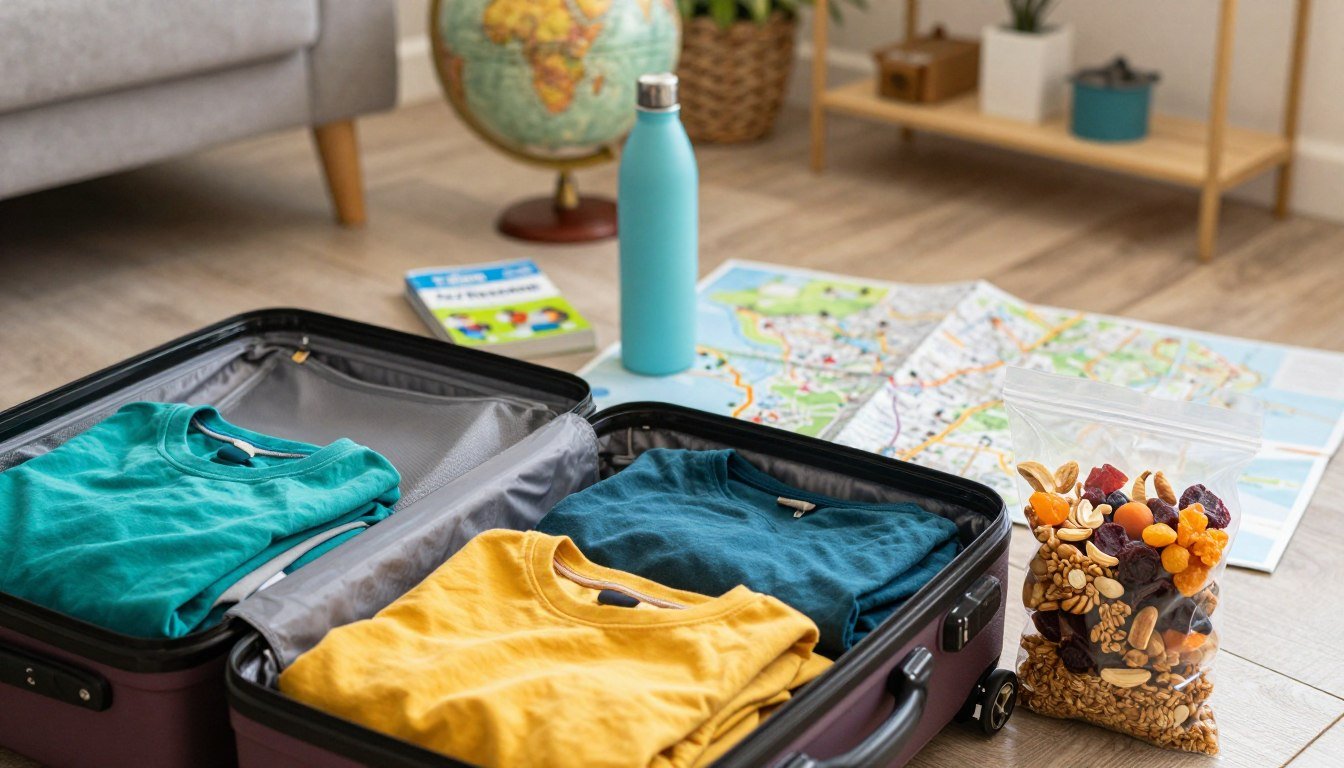
Frugal travel means deciding your money limits before you pack, and it works better than hoping snacks will save you. The daily travel budget is the estimated amount one person spends per day on lodging, food, local transport, and sightseeing. I learned that the hard way on a long weekend in Chicago, where I treated the hotel minibar like a grocery store and spent more on almond clusters than on dinner.
Here is the good news: you do not need a spreadsheet with forty tabs to avoid that kind of trip. You need a few honest numbers and the nerve to say no at the gift shop. Along the way, I will also confess to my own souvenir spending, which has its own zip code.
Cheap trips are rarely accidents. They come from a plan that fits your wallet, and the goal is simple: saving money on vacation without turning every meal into a math problem.
Key Takeaways
- Set your daily travel budget before you book anything.
- Accommodation is usually the largest line in a trip budget.
- Check the checked bag fee before you pick a fare.
- Book flights and hotels with a timing plan, not on impulse.
- Budget for park passes and entry fees as their own line.
- Set a cap on souvenirs and include a free daily activity to balance the day.
Pick one budget line to control first, because that single choice saves more than skipping every coffee.
What a Realistic Daily Budget Looks Like
The estimated standard U.S. travel budget for 2026 is $240 per person per day. That figure covers accommodation, food, local transport, and sightseeing, the four lines that make up a daily travel budget. Think of it as the average traveler’s baseline, not a target you must hit.
The biggest slice goes to lodging. Accommodation takes $112 of that $240, nearly half. Food and dining follow at $62, local transport takes $26, and sightseeing and entertainment take $40.
| Category | Standard amount per day | Share of total |
|---|---|---|
| Accommodation | $112 | 46.7% |
| Food and dining | $62 | 25.8% |
| Local transport | $26 | 10.8% |
| Sightseeing and entertainment | $40 | 16.7% |
| Total | $240 | 100% |
If you travel with a family of four, multiply every line by four. The standard figure then reaches $960 per day before you buy a single souvenir, which is why the accommodation budget deserves your first look. Traveling as a group changes the math fast, so run the numbers for everyone who is coming.
The standard daily travel budget is an estimate for the average traveler, and a budget trip usually runs well below it.
I used to skip the math and pay for it later in tears and credit card interest. Now I start with the accommodation budget, since it is the biggest line and the easiest one to shrink with a smaller room or a different neighborhood. Keep the food budget and sightseeing money flexible day to day.
Write your own version of these five lines before you book anything, since the average is only a starting point.
Checked Bags, Carry-Ons and Other Airline Fees
Checking one bag on a domestic American Airlines flight costs $50, or $45 if you pay online in advance. That number surprised me the first time, when my suitcase held mostly snacks and the fee cost more than the snacks.
Airline fees are the sneakiest line in a trip budget because they show up after you think you are done. Most airlines treat a checked bag over 50 pounds as overweight. Your fare can look cheap until the counter adds baggage fees.

First and Second Checked Bag Fees
For domestic flights ticketed on or after April 9, 2026, American charges $50 for a first checked bag. Delta Air Lines charges $45 for a first checked bag and $55 for a second, for flights ticketed on or after April 8, 2026. Southwest Airlines charges $45 for a first bag and $55 for a second.
Frontier Airlines is the expensive outlier, with $79 for a first checked bag and $89 for a second. The checked bag fee is the same idea everywhere: the second bag always costs more than the first.
| Airline | First checked bag | Carry-on or weight rule |
|---|---|---|
| American Airlines | $50, or $45 online in advance | One carry-on and one personal item |
| Delta Air Lines | $45 | One carry-on and one personal item |
| Southwest Airlines | $45 | One carry-on and one personal item |
| Frontier Airlines | $79 | 40-pound checked bag threshold |
| United Airlines | Check your fare rules | Basic Economy allows only a personal item |
Carry-On and Weight Limits
For 2026, most major U.S. airlines allow one personal item and one carry-on in domestic economy. United Basic Economy is the exception, allowing only a personal item under the seat in front of you.
A personal item is the tote or small backpack that fits under the seat, and it is the bag I now pack everything into. Three habits keep the fees off your receipt:
- Pack only a personal item, and leave the big suitcase at home.
- Read the fare rules before you buy, since the bag terms sit in the fine print.
- Move heavy shoes and books into your carry-on to keep your checked bag light.
Weigh your bag at home, because the 40-pound line on Frontier flights is easy to cross with a few books.
Timing Your Flights and Hotel Search
Booking a domestic flight 1 to 3 months ahead often gets you a better price. Your booking window matters more than most people think, and it changes with the route and the season.
Cheap fares rarely include bags, so the price you saw may climb once you add one. International flights are often best booked 2-6 months ahead, though timing depends on the route and season.
Flight prices often look lower earlier in the week and higher toward the weekend, but this pattern isn’t guaranteed. Fare alerts show what your own route is doing, which tells you more than any general rule.
Skyscanner’s hotel search lists more than 3.2 million properties worldwide and compares prices across hundreds of providers. That makes it a fast way to check hotel deals before you commit to one listing.
Here are four booking habits I wish I had learned earlier:
- Set a fare alert for your route as soon as you know your dates.
- Check midweek departures against weekend ones.
- Compare hotels with hostels and apartments, since a cheap room isn’t always the cheapest stay.
- Check the price again a day before you book, and rebook if it dropped.
Set a price alert and check it twice a week, since fares move more than most people expect.
National Park Passes and Free Entry Days
The 2026 America the Beautiful Resident Annual Pass costs $80 plus $7.50 in fees and covers entrance fees at federal sites for 12 months from the month you buy it. For a family that visits several paid parks in a year, that is usually worth a look.
The pass does not cover camping, boat launching, parking, or special tours. Budget for those extras separately, because they can add up faster than the entrance fee you saved.

The Resident Annual Pass
The Resident Annual Pass is for U.S. citizens and residents, and it covers entrance or standard day-use fees at National Park Service and other federal recreation sites. Children under 16 are admitted free at covered federal sites, so families with kids get value fast.
If you plan several paid park visits in one year, compare the total park entrance fee against the $87.50 cost before you buy. If you only visit one park, the math may favor a single entrance payment.
Senior, Access and Reservation Rules
Three pass types cover most travelers who want a discount:
- Resident Annual Pass: $80 plus $7.50 in fees, for U.S. citizens and residents, valid for 12 months.
- Senior Annual Pass: $20, for U.S. citizens and permanent residents aged 62 or older.
- Access Pass: free, for U.S. citizens and residents with permanent disabilities.
The Senior Lifetime Pass costs $80 for the same age group. Some national parks require timed-entry reservations, usually released on a rolling basis through Recreation.gov.
I once drove two hours to a timed-entry park with a pass in my glovebox and no reservation, and the ranger laughed kindly while I turned around. A pass gets you past the fee booth, but it does not give you a slot at the gate.
Check the reservation calendar on Recreation.gov before you drive, since a pass will not get you through a timed-entry gate.
Souvenirs Without Regret
Give your souvenirs their own line in the budget, or they will quietly eat your food money. A set amount keeps the gift shop from making decisions for you when you are tired and holding a tote bag full of snacks.
Souvenirs are where a tidy travel budget goes to die. I once bought eleven fridge magnets for people who never asked for them, and my fridge still holds them hostage.
Four souvenir rules keep the spending in check:
- Set a fixed souvenir cap for the whole trip.
- Buy one item per city, and make it count.
- Skip the shops at the airport, where prices run high.
- Photograph what you like and buy it later if you still want it.
The photo rule is my favorite because it turns an impulse into a decision. Most of the time, what you want in the moment looks less exciting on the couch at home.
Keep a running souvenir total on your phone so you can see the number before you pay.
Snacks, Sightseeing and Free Fun
Packing a few snacks from home can cut your food spending on a long travel day. A bag of fruit, nuts, and bread beats three gas-station meals. Packed snacks also keep you from the hangry decisions that cost the most.
Your sightseeing money goes further when you use free options first. Many museums offer free admission on set days, so check the schedule before you go.
- Do a grocery run on arrival so breakfast and lunch come from a store, not a hotel counter.
- Plan one free museum day into the trip, when admission costs nothing.
- Take a walking tour of the old town to see the main sights on foot.
A packed snack beats a bottle of water bought every hour, and the difference adds up over a week.
Local food is part of the fun, so save the restaurant splurge for one meal that you actually want. Try a street snack or a neighborhood bakery to get the flavor of the place without the sit-down bill.
Keep one free activity per day on the plan so a rainy afternoon doesn’t push you into an expensive shop.
Conclusion
The cheapest trip is the one where you set limits before you leave. I still remember the snack disaster in Chicago, when I came home with a sore wallet and a bag full of almond clusters. Setting numbers first would have spared me that little drama.
Keep the plan simple: one daily number, one bag rule, one souvenir cap, and one free activity each day. You don’t need to be perfect, just a little more deliberate than last time.
Write your daily number on a sticky note and put it in your wallet before your next booking.